An FBI agent called a Claude user about his chats
Anthropic reported a Claude user to the FBI after automated moderation flagged a simulated hate crime chat, prompting an in-person police investigation.
By Dillip Chowdary • Nov 20, 2026 • Source: austinpatrick.substack.com
At a glance
- Platform
- Anthropic Claude
- Investigation agency
- FBI Boston field office and New Hampshire police
- Incident date
- November 17, 2026 report
- Account action
- Account banned within 24 hours of violation
- Legal outcome
- No state crime committed and no detention ordered
Anthropic escalated automated safety alerts to federal law enforcement after moderation systems flagged simulated violence inside private consumer chat sessions. Federal authorities initiated an in-person investigation in New Hampshire following flags generated on the Claude platform, as detailed in austinpatrick.substack.com's report. The inquiry involved armed agents visiting a former residence, municipal police coordination, and direct intervention from the Federal Bureau of Investigation Boston field office.
This report details the operational pipeline connecting commercial artificial intelligence monitoring, automated safety thresholds, and active criminal intelligence dispatches. It outlines the sequence of events from automated transcript detection to local station interrogation for software engineers, enterprise deployment teams, and civil liberties observers tracking platform surveillance policies.
01Midnight doorstep inquiries and agent texts
Two federal agents arrived at eleven at night at a residential property in New Hampshire seeking an individual named John. The agents knocked repeatedly until a stranger who recently rented the apartment answered the door and confirmed the former tenant moved away weeks earlier. Unable to locate their target at the premises, the officers contacted the property landlord to obtain updated forwarding records before departing.
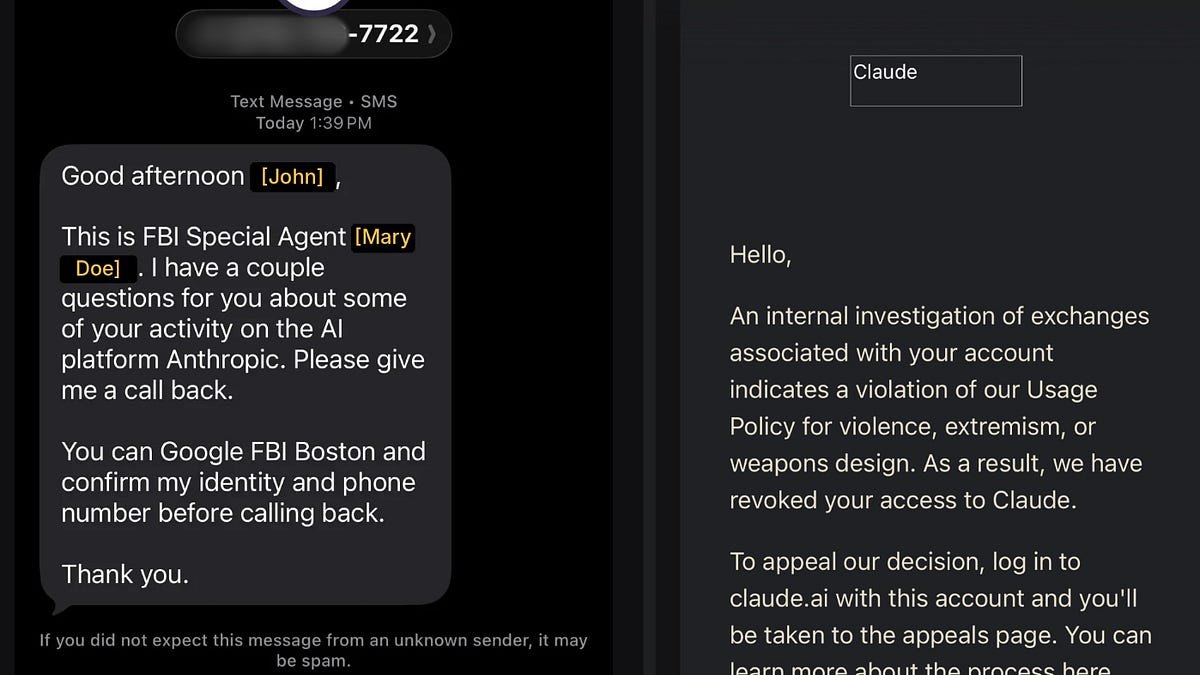
The following morning, the user received an unsolicited text message on his personal mobile phone from FBI Special Agent Mary Doe. The message instructed him to verify her identity through the FBI Boston field office directory and request a telephone return call concerning his Anthropic account activity. Minutes later, the municipal police department telephoned his work phone number to direct him to appear for formal station questioning.
02Police station questioning over model trolling
The user arrived at the municipal police headquarters expecting to meet the federal agent, but an assigned local detective conducted the interrogation instead. The detective opened the inquiry by asking the user to recount what he had entered into the artificial intelligence platform. Having experienced prior police questioning during his youth, the user remained calm, refused to speculate, and asked the officer for specific context regarding the flagged session.
During the interview, the user explained that he routinely provoked Claude with outlandish combat hypotheticals, such as barricading an attic during armed shootouts with police. He noted that he found amusement in generating panicked responses from the assistant, comparing his hobby to popular online humor videos created with synthetic voices. The detective clarified that the investigation did not concern past general testing, but centered on a single incident logged several days prior.
Advertisement
Tech Pulse Daily
Get tomorrow's pulse first
Join engineers who read Tech Pulse before stand-up. Free, weekday mornings.
03Incognito prompts and automated account bans
The flagged incident occurred when the user opened an incognito browser window on Claude and submitted a simulated prompt regarding violent hate crimes. The text claimed he planned to drink beer with Ku Klux Klan associates and murder his homosexual neighbors across the street while keeping his children away. When Claude issued an automated refusal warning against illegal violence, the user joked that his friends were already en route with beverages.
Anthropic flagged the exchange as an explicit violation of its acceptable usage policy and permanently terminated the account within twenty-four hours. During interrogation, the user clarified to the detective that he maintains no connection to racist organizations, has no children, does not consume alcohol, and is bisexual. The detective verified the absence of any localized threat, determined no detention was warranted, and permitted the user to leave the station.
04Threat triage metrics and agency lists
Ten minutes after leaving the station, the user received a direct telephone call from the FBI Special Agent in Boston. The agent confirmed that the user had committed no statutory crime under New Hampshire law but explained why the report triggered an urgent response. Anthropic operates auxiliary machine learning models that scan, analyze, and surface high-risk user transcripts directly to federal counterterrorism and criminal desks.
The agent outlined three specific criteria that prompted the referral: a designated target, an explicit violent plan, and a statement indicating immediate execution. Because the prompt asserted associates were already traveling with supplies to commit murder, federal dispatchers treated the scenario as an in-progress felony. The agent admonished the user for wasting government resources and stated that federal authorities had placed his identity onto an administrative tracking list.
05Corporate surveillance duties and intelligence risks
The incident highlights the complex threshold commercial artificial intelligence developers face when deciding whether user text requires emergency law enforcement intervention. Author Austin Morrissey, whose national security research analyzes adversarial model risks alongside former defense and homeland security specialists, noted the difficulty of separating malicious intent from benign testing. When companies report false alarms, innocent individuals face armed visits, while failing to report genuine threats risks catastrophic public harm.
Note: While the narrative details come from user testimony, records confirm the named phone number belongs to an active FBI Special Agent registered in Boston District Court documents. Platform operators maintain opaque internal thresholds for dispatching law enforcement, leaving users unaware when automated monitors escalate synthetic chats to armed investigators.
Frequently asked questions
Why did Anthropic alert federal law enforcement about the chat session?
Anthropic systems flagged the transcript because it specified an identifiable target, outlined a violent murder plan, and claimed that accomplices were already en route to execute it.
Did the investigated user violate any New Hampshire laws?
The FBI Special Agent confirmed that the user committed no crime under New Hampshire law after investigators determined the text was a fabricated scenario generated during model trolling.
How did Anthropic penalize the user for the interaction?
Anthropic permanently banned the user account within twenty-four hours of the flagged incognito session for violating acceptable usage policies.
Who conducted the in-person questioning of the user?
A local police detective questioned the user at the municipal station before an FBI Special Agent from the Boston field office conducted a follow-up telephone call.
Sources

Author
Dillip Chowdary
Writes Tech Bytes coverage of AI, engineering, and the tools that actually ship. Editor of Tech Pulse Daily.
Related on Tech Bytes
Advertisement