Harness adapters: adapt your favorite model to your harness to improve
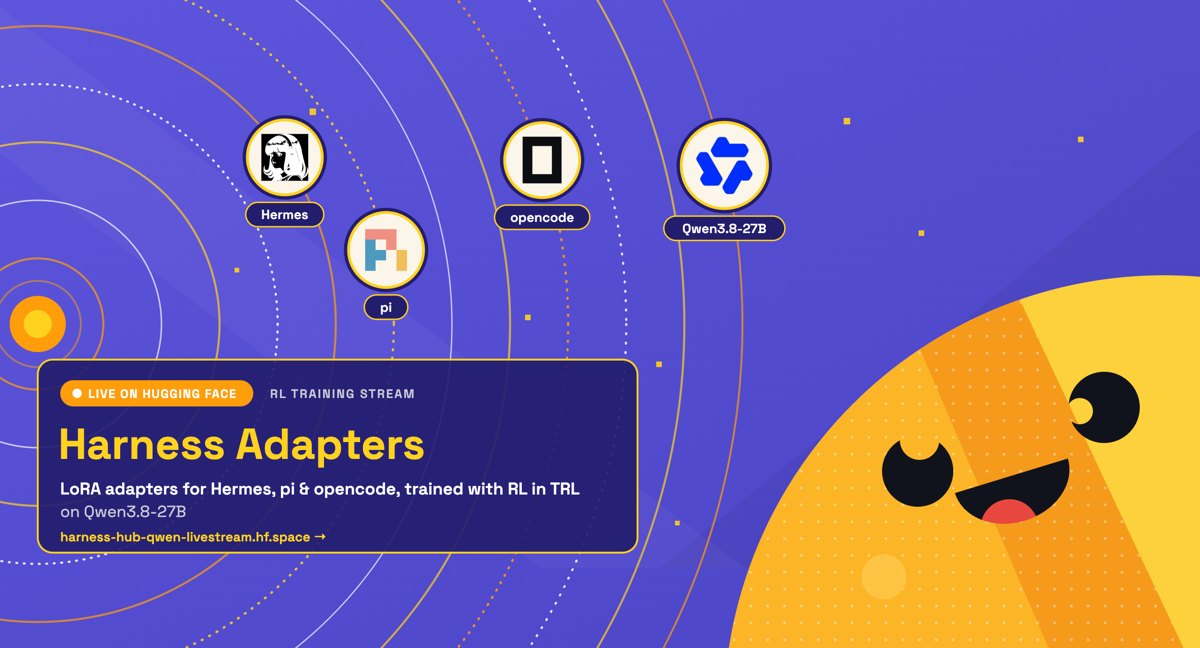
Hugging Face released harness adapters for Qwen3.8-27B, boosting Terminal-Bench 2.1 pass rates from 39% to 55% while cutting average token usage to 1.5K.
By Dillip Chowdary • Nov 20, 2026 • Source: Hugging Face Blog
At a glance
- Release date
- November 20, 2026
- Base model
- Qwen3.8-27B
- Supported harnesses
- Pi 1.5.2, OpenCode 2.2.7, Hermes Agent v0.22.6
- Pass rate
- 55% pass@1 on Terminal-Bench 2.1
- Token consumption
- 1.5K average tokens per task
- Availability
- Hugging Face collection repository
Hugging Face launched a reinforcement learning recipe that trains custom Low-Rank Adaptation harness adapters inside real agent runtimes. According to Hugging Face Blog's report, the team published specialized adapters for Qwen3.8-27B that boost task accuracy while reducing token consumption across popular coding environments. The release includes dataset generation pipelines, pre-built Docker containers, training configurations, and merged multi-harness weights.
This analysis examines how in-harness training operates, how training tasks are synthesized and validated, and how specialized adapters are merged into unified models. It is written for engineers, researchers, and system architects building autonomous agent pipelines who require higher accuracy without expanding model size.
01Docker runtime environments and harness proxy recording
Hugging Face trained Qwen3.8-27B directly inside native agent frameworks rather than using simulated training loops. The team packaged Pi 1.5.2, OpenCode 2.2.7, and Hermes Agent v0.22.6 into production Docker images via Harbor integration in OpenEnv and TRL's OpenEnv guide. A dedicated proxy intercepted execution between each agent harness and vLLM to capture exact generated tokens.
Traditional reinforcement learning frameworks constrain agents to custom interfaces like verl's AgentLoop, SkyRL-Gym, rLLM classes, or slime rollout functions. In contrast, this approach runs unmodified deploy-time harnesses while the trainer learns from real terminal interactions. The methodology aligns with paradigms like Agent Lightning v1.0 and SkyRL's Harbor integration that preserve production harness behavior.
02Synthetic bug injection and pull request harvesting
The training pipeline curated coding environments across three distinct origin streams. SWE-smith supplied volume by injecting synthetic bugs into real Python and Go repositories using model rewrites and operator mutations. Real-world defect coverage came from SWE-Gym tasks packaged inside TaskTrove, converting merged GitHub issues into verifiable Harbor challenges.
To address capability gaps, engineers utilized Tasksmith within Repo2RLEnv to construct tasks from 30 merged pull requests. This targeted critical agent skills tested in Terminal-Bench 2.1, DeepSWE, and SWE-bench Pro, including HTTP streaming, serialization, and filesystem operations. Tasksmith produced 24 verified tasks across 10 Python repositories, with 17 passing on a second run.
03Semantic validation suites on Hugging Face Jobs
Advertisement
Tech Pulse Daily
Get tomorrow's pulse first
Join engineers who read Tech Pulse before stand-up. Free, weekday mornings.
Candidate environments faced strict automated screening before entering the training pool. Initial metadata filters discarded non-permissive licenses, duplicates, and any repository overlapping with the 253 evaluation tasks from target benchmarks. Hugging Face Jobs executed openenv validate commands inside isolated sandboxes to verify four core semantic properties across every environment.
The validation suite verified reference solution rewards under semantic.oracle_max and confirmed that inactive baselines scored lower under semantic.floor_gap. It guaranteed that canaries never exceeded inactive baselines under semantic.canary_floor, while runtime.episode_determinism verified replay rewards. Exactly 858 of 1,127 candidates passed, catching defective regex-log verifiers and incomplete Tasksmith implementations.
04Group relative policy optimization difficulty screening
Because Group Relative Policy Optimization calculates updates by contrasting multiple attempts on identical problems, tasks with uniform success or failure provide zero gradient. The team evaluated Qwen3.8-27B across 442 candidate tasks using four to eight attempts per challenge. The base model solved 151 tasks every time and failed 120 completely, leaving 171 challenges for the qualified set.
Performance profiles varied across problem sources during the qualification phase. The base model consistently solved Go challenges, failed every attempt on over one-third of SWE-smith Python tasks, and achieved intermediate completion on 73% of SWE-Gym tasks. The team admitted 278 validated environments directly into training, while 522 rejected tasks were routed to Tasksmith for repair.
05LoRA benchmark efficiency and super adapter merging
Training specialized LoRA adapters yielded substantial accuracy improvements alongside efficiency gains for Qwen3.8-27B. Under the Pi harness on Terminal-Bench 2.1, the adapted model improved task completion while cutting token consumption nearly in half. Engineers observed that the fine-tuned model solved tasks by reasoning more concisely, invoking fewer external tool calls, and succeeding on initial attempts.
| Model configuration | Terminal-Bench 2.1 pass@1 | Average token usage |
|---|---|---|
| Base Qwen3.8-27B | 39% | 2.9K tokens |
| LoRA-adapted Qwen3.8-27B | 55% | 1.5K tokens |
Beyond individual harness checkpoints, Hugging Face merged the three specialized LoRA adapters into a single consolidated super-adapter. This unified model runs across Pi, OpenCode, and Hermes Agent without architectural changes, outperforming the base model across target benchmarks. The workflow relies on TRL's AsyncGRPOTrainer alongside OpenEnv and Harbor execution components.
Note: All project deliverables, including harness-specific LoRA adapters, merged super-adapter weights, quantized GGUF files, validated reinforcement learning task environments, and the safeagents evaluation plugin, are available directly for public download through the official Hugging Face collection.
Frequently asked questions
What performance improvement does the harness adapter provide?
On Terminal-Bench 2.1 with the Pi harness, the LoRA adapter raised Qwen3.8-27B pass@1 accuracy from 39% to 55%. It also reduced average token consumption from 2.9K down to 1.5K tokens per task.
Which agent harnesses were evaluated during training?
Hugging Face evaluated Pi 1.5.2, OpenCode 2.2.7, and Hermes Agent v0.22.6. The team also merged the trained weights into a super-adapter compatible with all three harnesses.
How were reinforcement learning coding tasks validated?
Tasks underwent automated testing with openenv validate on Hugging Face Jobs. The suite verified oracle maximum rewards, baseline floor gaps, canary score limits, and episode determinism.
What tool recorded training tokens inside the agent loop?
A proxy positioned between the agent harness and vLLM captured execution tokens directly. This enabled reinforcement learning on production harness runs without rewriting agent loops.
Sources

Author
Dillip Chowdary
Writes Tech Bytes coverage of AI, engineering, and the tools that actually ship. Editor of Tech Pulse Daily.
Related on Tech Bytes
Advertisement