Korea Advances Physical AI Across Industries With NVIDIA
Samsung, Kakao Mobility, and LG Electronics are deploying NVIDIA physical AI and Thor compute architectures across chipmaking, transit, and factory robotics.
By Dillip Chowdary • Nov 09, 2026 • Source: NVIDIA Blog
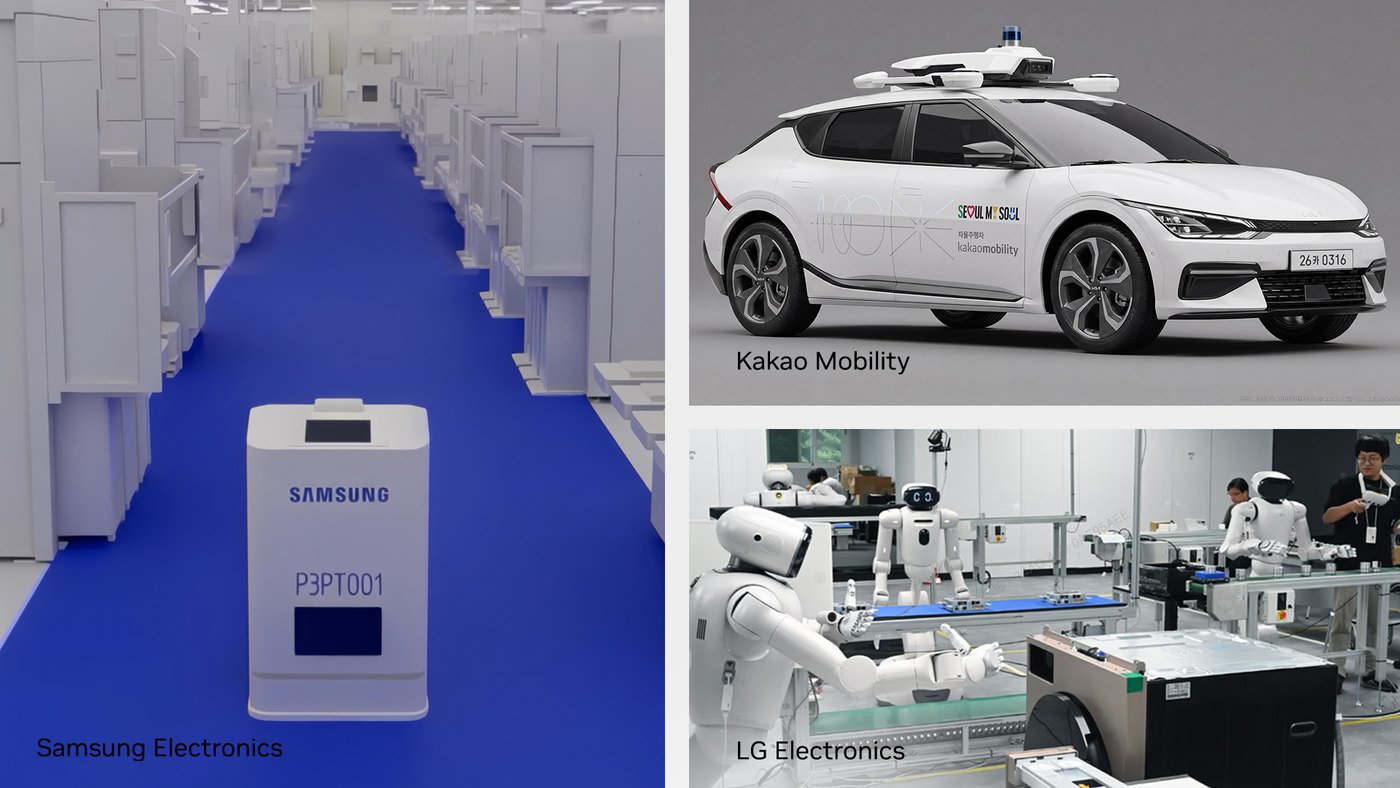
South Korea's major industrial champions are expanding their partnerships with NVIDIA to deploy accelerated computing, simulation, and physical artificial intelligence directly across factory floors, chip foundries, and public transit corridors. According to NVIDIA Blog's report, Samsung Electronics, Kakao Mobility, and LG Electronics are integrating NVIDIA's specialized hardware and software platforms into commercial production pipelines. Rather than confining artificial intelligence to digital interfaces or text generation, these initiatives apply machine learning and physics models to tangible operational systems ranging from semiconductor lithography to autonomous mobility.
This breakdown covers the technical integrations and operational architectures announced across the Korean manufacturing and autonomous transit sectors. It provides an engineering overview for systems architects, robotics engineers, and semiconductor researchers tracking real-world physical AI deployments. The initiatives focus on practical production challenges, showing how specialized computing hardware, physical simulation frameworks, and custom software pipelines can cut down design cycles and automate complex industrial workflows.
01What actually changed
Industrial production lines and transit networks across South Korea are integrating NVIDIA's physical AI frameworks into existing commercial engineering workflows. Samsung Electronics broadened its ongoing collaboration with NVIDIA to apply accelerated computing and AI physics across its materials research, chip process development, and device engineering teams. Instead of relying solely on conventional computing clusters for technology computer-aided design, the semiconductor manufacturer deployed libraries designed to tackle sparse linear systems and high-throughput optical calculations.
At the same time, autonomous transit and robotic assembly tasks moved into physical testing. Kakao Mobility committed to building a Level 4 autonomous driving system that combines its proprietary software stack with NVIDIA's reference vehicle architectures.
Concurrently, LG Electronics conducted live factory floor demonstrations using its CLOiD robot powered by NVIDIA's robotics models. These initiatives move physical AI from isolated research laboratories into daily manufacturing and commercial driving validation.
02How it works
Samsung is also exploring NVIDIA cuEquivariance to streamline tensor operations during training and inference for atomistic AI models. To analyze chip-scale thermal and mechanical stress, Samsung adopted NVIDIA PhysicsNeMo, combining AI-predicted material properties with coarser grids and GPU acceleration to reduce an 18-hour, 32-core CPU fine-grid solve down to 41 seconds. Looking ahead, Samsung plans to use NVIDIA Agent Toolkit to link these simulation engines and AI models for automated design exploration.
Samsung is also exploring NVIDIA cuEquivariance to streamline tensor operations during training and inference for atomistic AI models. To analyze chip-scale thermal and mechanical stress, Samsung adopted NVIDIA PhysicsNeMo, combining AI-predicted material properties with coarser grids and GPU acceleration to reduce an 18-hour, 32-core CPU fine-grid solve down to 41 seconds. Looking ahead, Samsung plans to use NVIDIA Agent Toolkit to link these simulation engines and AI models for automated design exploration.
Kakao Mobility is structuring its Level 4 autonomous vehicle development around NVIDIA Hyperion sensor and compute reference architectures powered by NVIDIA DRIVE AGX Thor. The company is coupling this hardware baseline with NVIDIA Halos to maintain safety standards throughout system development and validation, planning initial fleet integrations around Kia purpose-built vehicles.
For industrial automation, LG Electronics demonstrated manufacturing manipulation using its CLOiD robot driven by NVIDIA Isaac GR00T foundation models. The setup runs a data flywheel that pairs physical data capture with NVIDIA Cosmos-based synthetic data augmentation, Isaac GR00T model training, onboard execution on NVIDIA Jetson AGX Thor modules, and simulation-based verification.
Advertisement
Tech Pulse Daily
Get tomorrow's pulse first
Join engineers who read Tech Pulse before stand-up. Free, weekday mornings.
03Why it matters
Simulating semiconductor mechanics and training physical robots traditionally demands immense compute budgets, creating long bottlenecks between initial design and volume manufacturing. Samsung's deployment of PhysicsNeMo demonstrates that pairing AI-driven homogenization with GPU-accelerated solvers can deliver a 1,600x speedup in thermal and mechanical analysis. Cutting simulation turnaround from three-quarters of a day to under a minute allows chip designers to evaluate dozens of packaging configurations in the time previously required to run a single test.
In robotics and autonomous transit, physical AI workflows bridge the gap between simulation benchmarks and unpredictable real-world environments. Kakao Mobility can leverage operational data gathered from its commercial ride-hailing services in Seoul's Gangnam district while offloading compute-intensive sensor fusion to automotive-grade hardware. For LG Electronics, closing the loop between factory-floor collection, Cosmos data augmentation, and Jetson AGX Thor inference establishes an iterative framework where assembly robots continuously learn and adapt without stalling active production operations.
04Who is affected
Semiconductor process engineers and computational materials scientists at Samsung are directly affected as their design workflows transition from traditional multi-core CPU clusters to specialized GPU libraries. Teams working on atomistic modeling and thermal packaging can iterate through materials formulations and stress analyses in real time. Future engineering teams may also interact with autonomous digital agents orchestrated through NVIDIA Agent Toolkit to run comparative analyses across complex design spaces.
Autonomous vehicle engineers and fleet operators at Kakao Mobility will transition developmental driving algorithms onto standardized DRIVE AGX Thor and Hyperion architectures. Passengers and transit planners in South Korea will see these systems deployed across Kia purpose-built vehicles tailored for high-density urban transit. On factory floors, assembly line technicians and automation specialists at LG Electronics will work alongside CLOiD robotic platforms executing physical manipulation tasks validated through real-world manufacturing trials.
05What to watch
Technical milestones over the coming quarters will center on Kakao Mobility's vehicle integration timelines and real-world testing milestones. Observers should track how Kakao Mobility translates its Gangnam commercial driving data into Kia purpose-built vehicle prototypes running on NVIDIA DRIVE AGX Thor and NVIDIA Halos validation systems. The progression from closed-track validation to public Level 4 autonomous transit deployments will test whether NVIDIA's automotive computing stack meets strict domestic safety and regulatory standards.
Inside manufacturing facilities, the focus will remain on deployment scale and agentic integration. Observers should watch whether Samsung Electronics formally connects NVIDIA Agent Toolkit to its cuISS, cuDSS, and PhysicsNeMo pipelines, shifting semiconductor simulation from engineer-directed scripts to semi-autonomous engineering workflows. Additionally, LG Electronics' deployment of the Isaac GR00T and Cosmos data flywheel will reveal whether repetitive robotic manipulation models trained on Jetson AGX Thor hardware can generalize across varied factory layouts without requiring extensive manual recalibration.
Korea Advances Physical AI Across Industries FAQ
What speedups did Samsung achieve in its semiconductor simulation workflows?
Samsung achieved a roughly 1,600x speedup in thermal and mechanical analysis by combining AI-predicted material properties, coarser grids, and GPU acceleration with NVIDIA PhysicsNeMo, reducing simulation runtimes from 18 hours on a 32-core CPU to 41 seconds on a GPU. Additionally, quantum chemical calculations on its sMOL platform ran up to 5x faster end to end using NVIDIA cuEST.
What hardware and software platforms are powering Kakao Mobility's autonomous vehicle project?
Kakao Mobility plans to deploy NVIDIA Hyperion sensor and compute reference architectures powered by NVIDIA DRIVE AGX Thor, alongside NVIDIA Halos for safety validation, integrating its proprietary driving software into Kia purpose-built vehicles.
How did LG Electronics set up its robotic manufacturing demonstration?
LG Electronics demonstrated manufacturing manipulation tasks using its CLOiD robot powered by NVIDIA Isaac GR00T foundation models and NVIDIA Jetson AGX Thor onboard computing, supported by a data flywheel that incorporates NVIDIA Cosmos for data augmentation and simulation-based evaluation.
Sources

Author
Dillip Chowdary
Writes Tech Bytes coverage of AI, engineering, and the tools that actually ship. Editor of Tech Pulse Daily.
Related on Tech Bytes
Advertisement