Llama-modchip: 284B DeepSeek on 64GB RAM, no GPU
Synchopate launched llama-modchip v2.4.0, compressing the 284.33B DeepSeek-V4-Flash model to run entirely on 64GB CPU systems at up to 14.7 tokens per second.
By Dillip Chowdary • Nov 08, 2026 • Source: github.com
Synchopate released llama-modchip version 2.4.0, an open-source inference architecture that executes frontier mixture-of-experts models on standard workstation central processing units without requiring graphics cards. According to github.com's report, the system allows DeepSeek-V4-Flash, a 284.33-billion-parameter model with 13.17 billion active parameters, to run entirely inside system memory on standard 64-gigabyte machines at 256K context. The release also packages deployment runtimes for smaller architectures, executing Nvidia Nemotron-3.5-30B-A3B at speeds ranging from 25.0 to 111.62 tokens per second across multi-core processors.
This analysis details the compression math, cache hierarchies, kernel optimizations, and benchmark numbers implemented in the update. The breakdown is intended for software engineers, systems architects, and infrastructure teams evaluating whether commodity central processing units can replace dedicated accelerators for local frontier model inference and coding agents.
Llama-modchip: what actually changed
The software reduces the memory footprint of DeepSeek-V4-Flash from an uncompressed 76.87 gibibytes, which previously triggered out-of-memory crashes on 64-gigabyte Linux installations, down to 56.56 gibibytes on disk. When loaded with an active 256K context window, peak resident set size stays between 57.61 and 58.9 gibibytes of VmRSS, preventing out-of-memory terminations and avoiding NVMe disk swapping. On a 16-core AMD Zen 5 machine, processing throughput reaches 44.36 tokens per second during prompt prefill and delivers 9.06 to 10.74 tokens per second during pure processor generation, rising to 14.7 tokens per second with speculative drafting enabled.
Support also expands across lighter architectures running on consumer hardware. The 30.2-billion-parameter Nvidia Nemotron-3.5-30B-A3B, which activates 3.0 billion parameters per token across 23 state-space model layers, 23 mixture-of-experts layers, and 6 grouped-query attention layers, compresses into a 14.35 to 17.59 gibibyte footprint that fits within 16 to 32 gigabytes of system memory. For agentic development environments, the update introduces a dedicated CLI command that connects Claude Code across all 40 supported tools to a local 256K engine, reducing prompt re-evaluation delays from 45 seconds to a warm turn restore time of 13.1 to 32.6 milliseconds.
Llama-modchip: how it works
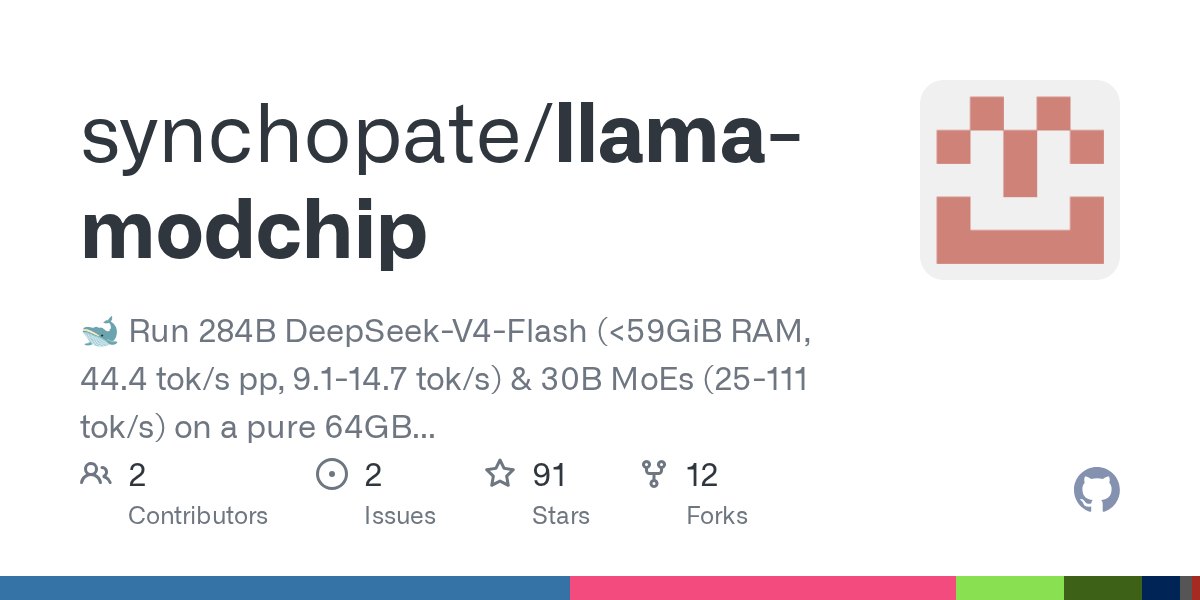
Memory reduction relies on analytical second-order SwiGLU-H2 Hessian compression combined with Fractal-64 multi-head latent attention transcoding at 3.75 bits per weight, which trims 20.31 gibibytes from the raw DeepSeek weight files. Weight matrices use custom block-64 BF16-scale Gray-coded tensors registered under GGML type identifier 40, coupled with exact singular value decomposition of attention projections that preserves 99.82 percent cosine similarity at a 25 percent rank reduction. Pruning layers employ second-order quadrature MoE pruning and gate-first SwiGLU execution to keep operations inside local L1 caches.
Execution speed on general-purpose chips is sustained through a four-level tiling pipeline spanning ZMM AVX-512BW 512-bit registers, 32-kilobyte L1 data caches, 1-megabyte L2 caches, and 64-megabyte L3 caches. Speculative decoding integrates a 1.64-megabyte Stockfish-PVS version 2 engine with a RouteCrack transposition table stored in L2 and L3 memory, hitting a 96.4 percent branch acceptance rate. Cache pollution is mitigated by tagging non-temporal memory streaming hints through dedicated intrinsic instructions, while agent sessions store persistent key-value states in shared memory under Slot-0 to bypass prompt recomputation.
Advertisement
Tech Pulse Daily
Get tomorrow's pulse first
Join engineers who read Tech Pulse before stand-up. Free, weekday mornings.
Llama-modchip: why it matters
Running 284-billion-parameter models directly on standard processor memory breaks the physical barrier that restricted frontier weights to clusters of dedicated enterprise accelerators. Standard dual-channel DDR5 desktop platforms can now process large codebases across full 256K context windows without requiring high-bandwidth memory or multiple 80-gigabyte enterprise graphics modules. The removal of cloud API requirements eliminates recurring inference expenses and external data leakage for corporate code repositories, while local execution avoids rate-limiting bottlenecks during automated agentic workflows.
The architecture demonstrates that mixture-of-experts designs can match dedicated hardware throughput when memory pipelines align with modern processor cache topology. Achieving 60.4 to 111.62 tokens per second on 30-billion-parameter models matches interactive reading speeds on developer hardware. Furthermore, by optimizing warm prompt swaps to under 33 milliseconds, development teams gain responsive local coding assistants that retain complete tool suites without stalling between tool calls or generating continuous subscription fees.
Llama-modchip: who is affected
Software engineers running local agentic workflows are immediately affected, particularly those deploying command-line coding assistants on machines with 16 to 64 gigabytes of memory. Developers using 16-core AMD Zen 5 chips, including Ryzen 9 9950X, 9955HX, and EPYC 9005 processors, can execute full-depth mixture-of-experts models locally. Users on AMD Zen 4 multi-CCD hardware such as the 64-core Threadripper PRO 7985WX gain automated topology discovery that enforces a four-core per CCD stride, circumventing Infinity Fabric saturation and providing a 54 percent speed advantage over running across all 64 cores simultaneously.
Teams operating hybrid setups can leverage tensor-role splitting to divide computation between host processors and consumer cards, offloading attention backbones to 16-gigabyte graphics cards while keeping routed expert weights in system DDR5 memory. However, developers relying on standard deployment stacks face compatibility hurdles. Because Fractal-64 files rely on custom block-64 Gray-coded kernels and GGML type identifier 40, they fail to load on unpatched upstream llama.cpp, Ollama, or LM Studio distributions, requiring either the project CLI or the standalone pre-compiled server binary.
Llama-modchip: what to watch
Adoption will depend on how quickly upstream inference runtimes implement support for GGML type 40 and custom Fractal-64 kernels. Observers should track whether llama.cpp merges Synchopate's analytical SwiGLU-H2 kernels, which would allow standard tools like Ollama and LM Studio to consume these compressed checkpoints without custom binaries. The project community leaderboard will provide verification data as users submit benchmark scores across various consumer processors and cloud instances like AWS Graviton3 ARM64.
Further development centers on expanded model architectures and hybrid acceleration modes. Future updates will indicate whether alternative mixture-of-experts configurations, such as Qwen3-30B dynamic top-k routing and dense 8-billion-parameter Mamba-2 backbones, achieve parity across mobile and server chips. Progress in shared-memory restoration mechanisms will also demonstrate whether persistent key-value caching can scale beyond single-agent sessions to host concurrent multi-agent tool loops on workstation hardware.
Developer Action Items
- ☐ Diff the official changelog for Claude / Nvidia / GitHub 2.4.0 before you bump — APIs, defaults, and removed flags only.
- ☐ Install through the vendor's documented channel in staging; keep a one-command rollback and time-box the canary.
- ☐ Grep your repo for old flag names, lockfile pins, and plugin versions that the notes mark as breaking.
- ☐ Prefer the first patch cut over the day-zero tag unless you have a reason to be on the leading edge.
- ☐ If Hacker News Front Page did not name a region, plan, or SKU, screenshot the official availability line before you promise it to users.
Llama-modchip FAQ
What hardware is required to run the 284B DeepSeek model?
DeepSeek-V4-Flash requires a standard 64-gigabyte CPU workstation with AVX-512BW support, using 56.56 gibibytes of disk space and up to 58.9 gibibytes of RAM.
Can Fractal-64 GGUF models run in standard Ollama or llama.cpp?
No, unpatched runtimes fail because Fractal-64 uses custom block-64 Gray-coded tensors registered under GGML type 40, requiring the project's custom binary or CLI.
How does the system speed up Claude Code agent interactions?
It stores persistent key-value caches in shared memory at /dev/shm Slot-0, restoring agent context across 40 tools in 13.1 to 32.6 milliseconds instead of re-evaluating prompts for 45 seconds.
Sources

Author
Dillip Chowdary
Writes Tech Bytes coverage of AI, engineering, and the tools that actually ship. Editor of Tech Pulse Daily.
Related on Tech Bytes
Advertisement