Meridian: A peer-to-peer browser game world built by an AI agent
Blake La Pierre deployed a zero-install browser build of Meridian on GitHub Pages, featuring peer-to-peer WebRTC networking and WebGL2 ray tracing.
By Dillip Chowdary • Nov 01, 2026 • Source: blakelapierre.substack.com
Blake La Pierre released a major update to Meridian, an experimental peer-to-peer browser game planet constructed using Grok Build Mode, rolling out a direct zero-install demo hosted on GitHub Pages alongside an expanded suite of simulation systems. According to blakelapierre.substack.com's report, every open pull request has merged into the project main branch, introducing spatial audio, hearing skills, an adaptive ray-traced renderer, trampled paths, and a dedicated fix for blank mobile screens. The architecture allows participants to boot the environment directly inside a modern desktop or mobile browser without native installations, running solo sessions locally whenever matchmaking infrastructure is absent.
This technical breakdown examines the networking architecture, automated player mechanics, rendering pipeline, and progression systems powering Meridian's decentralized world simulation. It is written for graphics engineers, web developers, distributed systems architects, and simulation enthusiasts evaluating how autonomous development agents construct complex multi-client software. The update demonstrates how WebRTC data channels, fallback software rendering passes, dynamic skill development, and browser-driven procedural mapping can operate together across desktop hardware and touch devices without relying on dedicated central game servers.
A peer-to-peer browser game world built: what actually changed
The most significant change in this release is the elimination of installation requirements through a public browser demo deployed on GitHub Pages. Players on phones and tablets receive dedicated touch controls, using a virtual thumbstick on the left screen for movement, right-side drag gestures for camera orientation, and a dedicated Fire button replacing standard desktop mouse clicks. The project also incorporates a four-step first-minute onboarding tour that guides newcomers to walk to a yellow marker, shoot a red practice dummy, dig sand at their feet, and press E at a gate to join a strike. Debug overlays and network diagnostics are hidden by default behind an I key toggle or specific query parameters.
Behind the scenes, the development agent merged a comprehensive batch of design-note mechanics directly into the simulation code. These newly simulated systems include a landing counter, reload beats, recovery phrases, and physical wind drag applied across moving bodies. The main branch now carries a formal verification suite spanning 241 unit tests, where 236 pass and five skip because they require headless Chromium to evaluate multi-browser synchronization. Network connectivity has transitioned to a solo-by-default posture that displays a notification reading multiplayer server offline when the temporary public discovery server is unreachable, while maintaining full query flag support for custom connections.
A peer-to-peer browser game world built: how it works
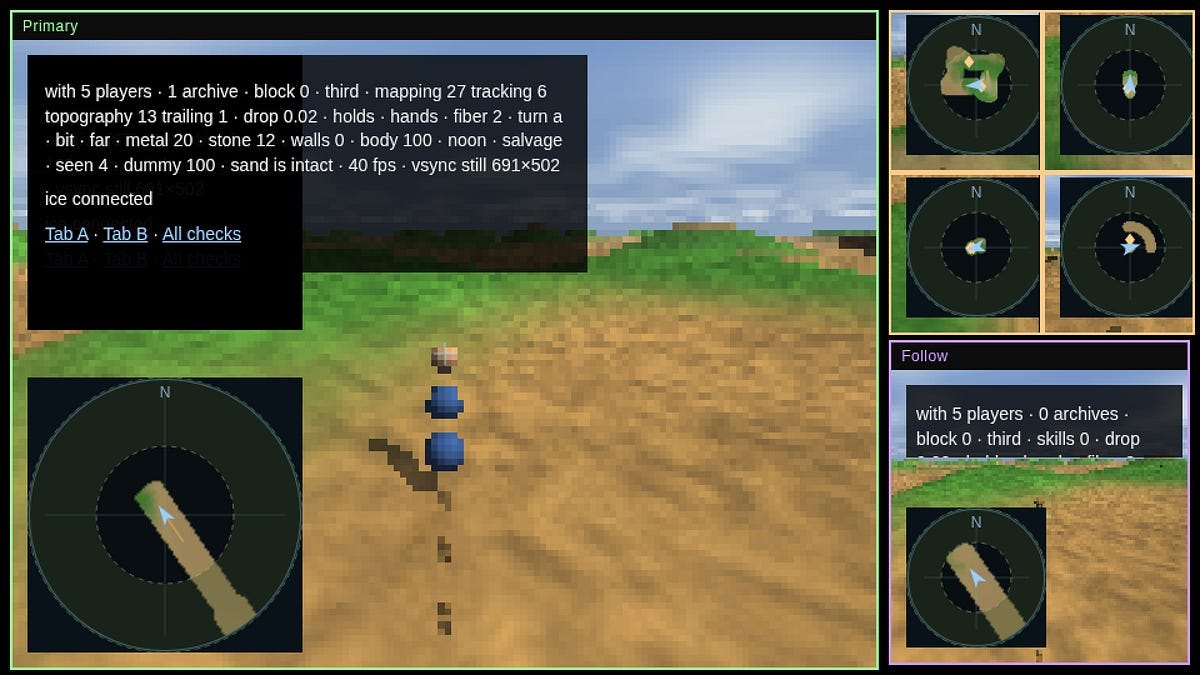
The graphics engine renders character viewpoints using a WebGL2 ray pass executed directly on the graphics card, automatically routing computations through a CPU software renderer if hardware acceleration is absent. The rendering pass uses filmic tone mapping with dynamic exposure adjustments keyed to the sun position, preserving visual contrast during dusk and night cycles. Rays cast at close terrain intersections execute at full resolution, whereas distant geometry traces at one-quarter resolution to preserve compute cycles. A dynamic pacing threshold enforces a minimum floor of 12 frames per second while moving objects are visible, alongside a processing cap on the refinement duration of static frames.
Multiplayer coordination relies on WebRTC peer connections established through an external coordinator known as a lighthouse. The lighthouse only performs introductions to negotiate session links, after which game simulation data streams strictly peer-to-peer across client nodes. The charting system actively paints terrain colors onto a map wherever a player character casts their visual gaze rather than calculating flat projections ahead of their feet. Visual discovery radii and minimap zoom behavior scale directly from character perception attributes, specifically the eyesight stat trained through looking and the focus stat trained by sustaining fixed eye contact on objects in the environment.
Advertisement
Tech Pulse Daily
Get tomorrow's pulse first
Join engineers who read Tech Pulse before stand-up. Free, weekday mornings.
A peer-to-peer browser game world built: why it matters now
The architecture validates that decentralized web simulations can deliver stateful multi-entity experiences without requiring massive back-end infrastructure or proprietary client engines. By relying on WebRTC data channels instead of heavy authoritative server clusters, the simulation shifts the operational burdens of hosting, physics evaluation, and asset delivery directly onto client browsers. The inclusion of an automatic software rendering fallback guarantees that devices without discrete GPUs, such as integrated office workstations or entry-level phones, can still process ray passes, maintain consistent camera logic, and contribute to shared peer networks.
Additionally, the project illustrates how autonomous coding agents like Grok Build Mode interpret design documents and translate theoretical rules into concrete, verified codebases. Merging 241 automated tests alongside complex sub-systems demonstrates that agent-assisted development can tackle messy edge cases like mipmapped textures, edge-preserving upscaling, touch input emulation, and network failovers. Rather than functioning as an unplayable code mockup, the resulting environment compiles into a functioning multi-client bench capable of managing five interconnected browser clients simultaneously across standard web protocols.
A peer-to-peer browser game world built: who is affected
Web developers exploring decentralized applications and browser-based multiplayer games will find concrete implementation models for WebRTC connection lifecycles and peer topology management. When running multi-client benches, developers can inspect six simultaneous browser instances, including four automated AI clients and dedicated camera followers connected via ice connected WebRTC sessions. The simulation demonstrates how to structure automated AI peers using identical client interfaces and control mappings as human players, steering non-player agents through code-defined agendas like mining sand pits, surveying shorelines, or assembling modular stone structures.
Players accessing the public deployment gain immediate access to an interactive procedural world without downloading native executables or creating platform accounts. Mobile users receive adapted touch layouts that normalize gameplay across varying screen aspect ratios without triggering blank screen rendering bugs. Players also encounter an integrated RPG progression model where physical activities like sprinting and jumping cultivate agility, unlocking performance multipliers up to 1.5 times sprint speed, 1.4 times jump height, and 1.5 times keyboard turn velocity at peak experience ranks.
A peer-to-peer browser game world built: what to watch
Observers should track the stability of the peer-to-peer mesh when larger groups of browser clients attempt to synchronize shared world states over custom WebRTC lighthouses. While the current public deployment defaults to solo operation, users can supply custom signaling servers using the lighthouse query parameter or enforce solo isolation with explicit flags. Monitoring how peer connections behave under variable network latency will reveal the limits of serverless browser-to-browser gaming, particularly when distributed entities alter terrain, exchange mapping data, or construct structural walls on specific gray rock footings.
Attention will also center on further refinements to the procedural charting and multi-agent coordination models. In test runs, autonomous surveyor clients successfully mapped square island circuits, elevating tracking skills from 5 to 24 while follower clients mirrored walking routes despite holding zero native skills. Seeing whether autonomous builders, marksmen, and miners can execute synchronized cooperative goals across peer networks will indicate how effectively agentic codebases manage distributed emergent behaviors in open browser sandboxes.
Developer Action Items
- ☐ Diff the official changelog for GitHub before you bump — APIs, defaults, and removed flags only.
- ☐ Install through the vendor's documented channel in staging; keep a one-command rollback and time-box the canary.
- ☐ Grep your repo for old flag names, lockfile pins, and plugin versions that the notes mark as breaking.
- ☐ Prefer the first patch cut over the day-zero tag unless you have a reason to be on the leading edge.
- ☐ If HN AI Agents did not name a region, plan, or SKU, screenshot the official availability line before you promise it to users.
A peer-to-peer browser game world built FAQ
What happens if WebGL2 is not supported on a player device?
The engine automatically falls back to a software CPU renderer to ensure the game environment remains functional without dedicated graphics acceleration.
How does multiplayer networking function without a central server?
Game traffic moves peer to peer over WebRTC connections, using an optional lightweight lighthouse service solely to introduce browser clients to one another during initial matchmaking.
How does the in-game map generate terrain data?
The map reveals terrain colors based on where the player character looks using their visual line of sight, expanding its radius according to the character's trained eyesight and focus skills.
Sources

Author
Dillip Chowdary
Writes Tech Bytes coverage of AI, engineering, and the tools that actually ship. Editor of Tech Pulse Daily.
Related on Tech Bytes
Advertisement