Paradev: One workspace for Claude Code, Codex, and any coding agent
Superset rebranded to Paradev and raised an $11.5M seed round to launch an orchestration workspace that runs more than 100 parallel coding agents.
By Dillip Chowdary • Oct 26, 2026 • Source: paradev.com
The developer tooling startup previously known as Superset announced its corporate rebrand to Paradev alongside an 11.5 million dollar seed funding round, delivering a dedicated desktop and remote orchestration environment designed to run dozens of autonomous programming tools concurrently. As detailed in paradev.com's report, the platform introduces a unified graphical workspace that coordinates command-line agents including Claude Code, OpenAI Codex, OpenCode, Gemini, and Cursor Agent without forcing developers to juggle separate terminal windows or risk directory conflicts. Engineered specifically around Git worktree isolation, the software lets engineers trigger parallel branches, execute background test suites, connect to high-performance remote servers, and review incoming pull requests from a single interface. The release is distributed for macOS alongside mobile companion interfaces and terminal scripts, establishing an orchestration layer that allows software teams to treat autonomous CLI agents as a scalable, coordinated workforce rather than isolated, single-threaded prompt loops.
This breakdown details the architecture, automation capabilities, remote hardware connections, and security standards introduced in the Paradev platform. The release directly targets systems architects, engineering managers, and individual contributors who already rely on terminal-based coding tools but face bottlenecks when managing concurrent coding sessions on complex codebases. Instead of locking teams into proprietary model providers or imposing managed API markups, the workspace preserves developers' existing commercial subscriptions and local workflow conventions. Readers will learn how the system organizes multi-agent execution across local laptops and remote compute boxes, how scheduled automations handle repetitive engineering chores, how Git worktree isolation prevents branch clobbering, and how engineers can integrate their current terminal-based workflows with minimal operational overhead.
What shipped in One workspace for Claude Code
Paradev shipped a desktop application for macOS and a companion mobile interface that manages parallel coding tasks across desktop, cloud, remote servers, and command-line interfaces. The core environment features a visual workspace manager displaying live status indicators for active tasks, including branch creations, onboarding crash fixes, billing webhook updates, authentication refactors, and dependency bumps. Within the terminal pane, developers can run Claude Code version 2.1.278 using Fable 5.1 with high effort and Claude Max authentication profiles, alongside OpenAI Codex, OpenCode, Cursor Agent, Mistral Vibe, Kimi Code, Grok CLI, Hermes, Muse Code, Devinfx, Antigravity, and Kiro. The interface integrates the superset-mcp server configured through dot mcp dot json, allowing agents to execute tasks, inspect file diffs, push branch changes, and generate draft pull requests within single-digit second execution intervals.
Beyond local desktop operation, the platform delivers built-in remote host connectivity that attaches external infrastructure such as sixty-four core, one hundred twenty-eight gigabyte machines hosted in us-east regions via secure shell. Workspaces running on remote instances keep executing when a user closes their laptop lid, and mobile interfaces allow engineers to plan, query, review, and merge branches directly from iOS or Android devices. The release also ships an automation runner capable of executing scheduled jobs, including daily triage at nine in the morning, Sunday changelog drafts at eleven, weekly dependency upgrades, and event-driven pull request reviews. Engineers can drive the system entirely from the command line using the superset executable, allowing them to spawn new named workspaces with designated agents, list active sessions, and script complex continuous integration flows.
What improved in One workspace for Claude Code
The primary engineering enhancement centers on replacing single-threaded terminal windows with an orchestration engine capable of scaling beyond one hundred parallel agents simultaneously. In traditional command-line setups, launching multiple coding agents within the same repository directory risks collision, overwritten files, and corrupted git states. Paradev eliminates this vulnerability by assigning every concurrent task to its own isolated Git worktree, allowing dozens of autonomous tools to modify code, run test suites, and stage commits without stepping on adjacent work. The user interface provides side-by-side and inline diff visualizers showing additions and deletions across components such as hero sections, background modules, and schema definitions. Builders can review diffs, approve changes, and trigger merges without manually stashing branches or resolving file locks across competing agent processes.
| Architecture Dimension | Single CLI Terminal Baseline | Paradev Orchestrated Workspace |
|---|---|---|
| Agent Concurrency | 1 active process per terminal tab | Scale to 100+ agents running in parallel |
| Workspace Isolation | Shared repo working tree with collision risk | Independent Git worktree per active task |
| Execution Environment | Local machine process terminates on sleep | Remote host persistence (64 cores, 128 GB) |
| Session Control | Manual terminal multiplexing | Unified GUI, CLI, mobile, and MCP control |
| Task Automation | Manual execution of scripts and chores | Event triggers and cron schedules |
| Security & Compliance | Ad-hoc local security posture | SOC 2 Type II certified with local-first data |
| Source Licensing | Proprietary closed binary | Elastic License 2.0 (ELv2) source-available |
| Capital Backing | Unfunded / early-stage Superset | $11.5M institutional seed financing round |
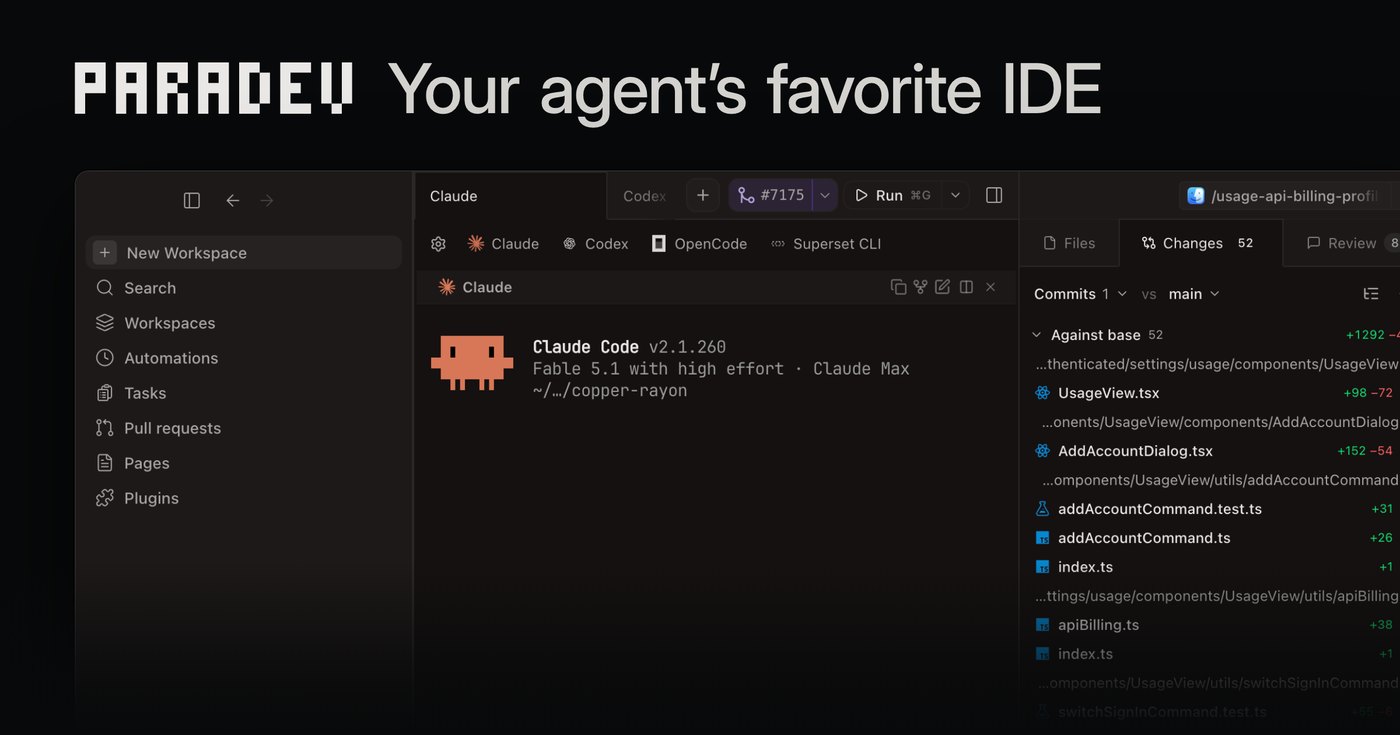
Operational flexibility improves significantly through vendor-neutral architecture and native editor interoperability. Rather than confining programmers to an unfamiliar proprietary text editor, Paradev integrates deep linking that launches active worktrees directly into Cursor, Visual Studio Code, Xcode, Sublime Text, JetBrains IDEs, Finder, or standard system terminals with a single keystroke. Security architecture also advances with SOC 2 Type II compliance certification and an Elastic License 2.0 source-available distribution model on GitHub. Because repositories, worktrees, terminal outputs, and session histories remain strictly on the user machine, corporate source code never traverses intermediate proprietary servers. Account and organization metadata represent the only information synced to cloud storage, ensuring private source trees remain private.
Advertisement
Tech Pulse Daily
Get tomorrow's pulse first
Join engineers who read Tech Pulse before stand-up. Free, weekday mornings.
What you gain from One workspace for Claude Code
Adopting the platform grants development organizations the ability to convert passive backlog chores into autonomous, parallel background executions that resolve without human intervention. Instead of spending morning hours triaging bug reports or updating third-party libraries, teams can assign automated routines that scan incoming issue queues, draft support replies, run validation tests, and submit complete pull requests for human sign-off. Testimonials from engineering leaders highlight this shift in daily velocity. Abhi Aiyer, co-founder and chief technology officer at Mastra, reported conducting all engineering work inside the environment since late December, while Chris Laupama, technical lead at Webflow, praised the setup as the definitive user experience for command-line coding agents. Similarly, Gregor Zunic, co-founder at Browser Use, noted that isolated worktrees and automated shortcuts eliminate friction when managing complex codebases.
Engineers also gain substantial financial and administrative sovereignty by preserving their existing direct vendor accounts and application programming interface credentials. Paradev avoids inserting proxy gateways between the developer and model providers, eliminating token surcharges, rate-limit throttling, and forced ecosystem migrations. Practitioners can run Claude Code on Anthropic Max quotas for architectural refactors, switch to OpenAI Codex for database scripts, and deploy OpenCode for routine test generation without altering their review workflows. Felipe Coury from OpenAI noted that developers seeking a graphical interface for parallel agents receive exceptional utility from the platform, while Cloudflare principal engineer Eric Clemmons confirmed adopting the workspace as his primary terminal environment. This broad agent compatibility ensures teams remain insulated against sudden pricing changes or platform shifts among underlying model vendors.
How to get One workspace for Claude Code
Developers running macOS can obtain the workspace directly as an installable desktop package distributed from the company domain, while command-line users can access repository source code published on GitHub under the Elastic License 2.0. Setting up the environment requires configuring local coding agents such as Claude Code on the host machine using standard package management channels. Once installed globally, the CLI utility allows engineers to authenticate their existing provider subscriptions and manage agent sessions directly from the terminal or through the desktop interface. To install or update the official Claude Code CLI tool globally, developers execute the standard package manager update command.
npm install -g @anthropic-ai/claude-code
claude update
Within the agent environment, developers can inspect available models and switch between intelligence tiers during an interactive session by triggering the slash model command. To launch pinned sessions that run specific model variants like Fable directly from shell prompts, users pass the model flag upon invocation. Global defaults can be configured within the agent settings so that all new workspaces spawn with the preferred configuration. Once Claude Code is configured, developers launch Paradev workspaces from the command line using the superset executable, specifying the task name and target agent flag to immediately generate an isolated Git worktree.
```bash
# In-app model switch during an active Claude Code session
/model fable
What to watch after One workspace for Claude Code
Following the eleven point five million dollar funding announcement and corporate rebrand, industry observers should monitor how rapidly enterprise development teams adopt multi-agent orchestration over conventional single-agent coding extensions. As autonomous CLI tools become more capable of executing multi-file edits, the bottleneck shifts from model generation speed to git branch management and continuous integration verification. Engineering organizations must track whether automated pull request creation introduces review debt for senior maintainers tasked with evaluating dozens of machine-authored changes daily. The performance of remote execution nodes, such as sixty-four core servers handling long-running evaluation suites, will also demonstrate whether offloading agent tasks to secondary hardware produces measurable savings in local battery life and workstation responsiveness during intensive debugging cycles.
Another critical factor to watch is the expansion of open-source and proprietary agent integrations supported within the workspace ecosystem. As new programming models and specialized coding tools emerge from providers like Anthropic, OpenAI, Mistral, and Google, Paradev must maintain compatibility across disparate command-line parameters, context window protocols, and tool-calling interfaces. Observers should also track enterprise compliance adoption, evaluating whether the combination of SOC 2 Type II certification, local-first repository boundaries, and the Elastic License 2.0 license encourages regulated financial and healthcare organizations to adopt autonomous agents. If parallel worktree orchestration becomes the standard developer interaction model, traditional integrated development environments may face pressure to incorporate native multi-agent coordination directly into their core applications.
Developer Action Items
- ☐ Diff the official changelog for OpenAI / Claude / Gemini 11.5 before you bump — APIs, defaults, and removed flags only.
- ☐ Install through the vendor's documented channel in staging; keep a one-command rollback and time-box the canary.
- ☐ Grep your repo for old flag names, lockfile pins, and plugin versions that the notes mark as breaking.
- ☐ Prefer the first patch cut over the day-zero tag unless you have a reason to be on the leading edge.
- ☐ If HN Claude/Codex/Fable did not name a region, plan, or SKU, screenshot the official availability line before you promise it to users.
One workspace for Claude Code FAQ
What is Paradev and how does it relate to Superset?
Paradev is the new name for Superset following a corporate rebrand and an 11.5 million dollar seed funding round. It is an orchestration workspace that allows developers to run multiple coding agents like Claude Code, Codex, and OpenCode in parallel.
How does Paradev prevent agents from overwriting project files?
The platform runs every individual agent in its own isolated Git worktree on an independent branch. This isolation ensures that concurrent agents can modify files, run tests, and open pull requests without interfering with one another.
Which AI coding agents are compatible with Paradev?
Paradev supports any command-line coding agent, including Claude Code, OpenAI Codex, OpenCode, Gemini, Cursor Agent, Mistral Vibe, Kimi Code, Grok CLI, Hermes, Muse Code, Devinfx, Antigravity, and Kiro. Users bring their own agent subscriptions and API keys without third-party proxying.
Can Paradev run tasks on remote servers and mobile devices?
Yes, Paradev connects to remote machines such as 64-core compute boxes over SSH so long-running tasks persist when laptops sleep. Developers can also monitor sessions, review code changes, and approve pull requests from an iOS or Android mobile interface.
Sources

Author
Dillip Chowdary
Writes Tech Bytes coverage of AI, engineering, and the tools that actually ship. Editor of Tech Pulse Daily.
Related on Tech Bytes
Advertisement